

Robotic Spine Surgery
At a Glance
- Robotic spine surgery is a minimally invasive spine surgery in which a surgeon uses a specialized robotic guidance system for greater precision.
- It’s best suited for people who have spinal stenosis, degenerative disc disease, spinal fractures, tumors, or require a spinal fusion or scoliosis correction.
Overview
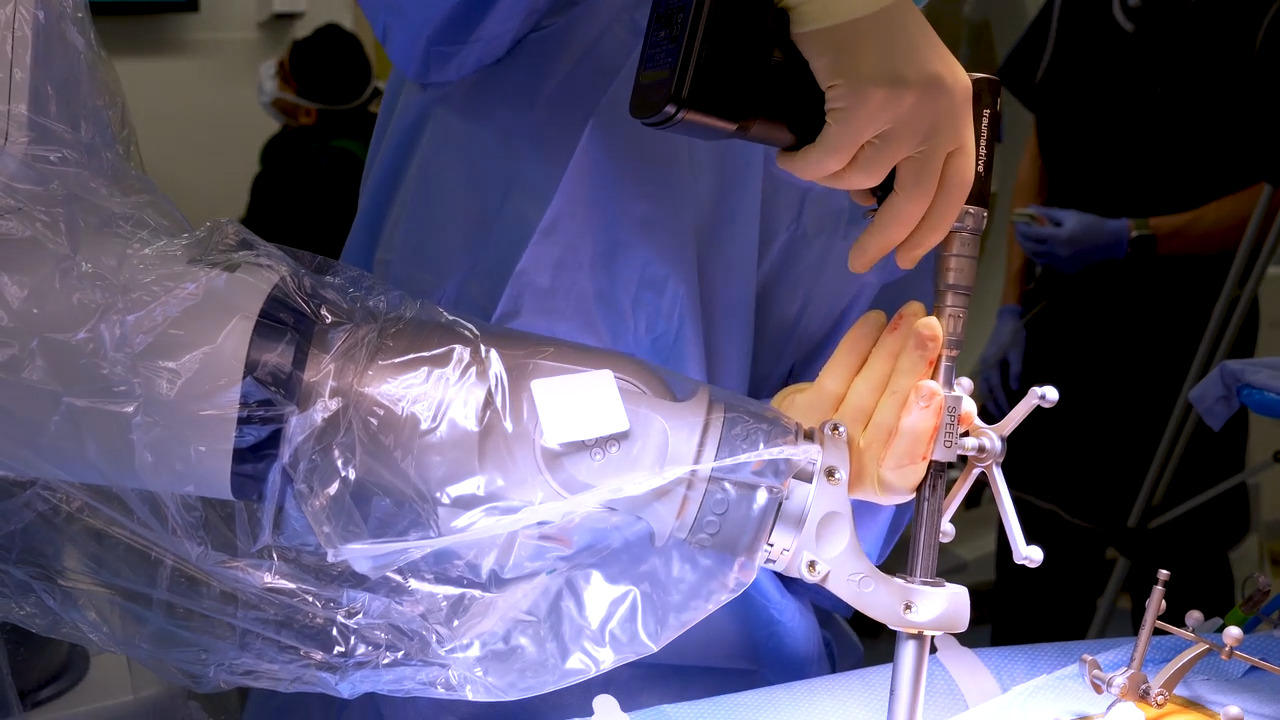
Robotic spine surgery is a minimally invasive spine surgery that uses a robotic guidance system to plan and perform a spinal procedure with extremely high precision. Despite its name, your neurosurgeon remains in control throughout the surgery—the robotic system operates more like an advanced navigation and positioning tool to guide instruments and implants.
The benefits of robotic spine surgery include:
- Greater accuracy: Studies have consistently shown that robotic screw and implant placement is more precise than in traditional spine surgery.
- Smaller incisions: The robotic system, combined with advanced image guidance, allows your neurosurgeon to place screws and hardware into the spine without having to visualize large sections of the spine directly.
- Less blood loss and faster recovery: As a whole, minimally invasive surgical techniques result in less blood loss and a faster recovery than traditional surgery.
- Less radiation exposure: Robotic guidance reduces radiation exposure for the patient, surgeon, and operating room staff when compared to traditional image-based spine surgery.
- Reduced risk of revision surgery: When spine surgery hardware is placed with even greater accuracy, it decreases the already small chance you could need surgery to revise the placement of rods, screws, and other materials.
How is robotic spine surgery different from traditional spine surgery?
In conventional spine surgery, surgeons rely on preoperative imaging to plan the procedure, with live X-ray guidance—called intraoperative X-ray fluoroscopy—during surgery. This works very well in skilled hands, but a screw placed even a few millimeters off can disrupt a nerve, blood vessel, or the spinal canal itself.
Robotic spine surgery dramatically augments your neurosurgeon’s ability to precisely place hardware, especially in people with abnormal or challenging anatomy. Ultimately, robotic spine surgery is like a super-accurate navigation system that helps spine surgeons perform surgery more precisely and less invasively.

How Robotic Spine Surgery Works
Typically, the process for robotic spine surgery includes the following steps:
- Procedural planning: Your surgical team will use computed tomography (CT) scans, magnetic resonance imaging (MRI), or specialized imaging to build an accurate 3D digital model of your spine. Your neurosurgeon will then use software to plan exactly where every screw, implant, or piece of hardware will go; mapping out the safest, most accurate path through your unique anatomy. This ability to extensively plan spinal operations is one of the biggest advantages of robotic surgery.
- In the operating room: Once you’ve undergone anesthesia and are carefully positioned on the operating table, the robotic system is set up and registered to your spine. This means the system’s internal map is synchronized with your anatomy. From this point on, it knows exactly where every millimeter of your spine is in real time, thanks to special digital markers.
- Performing surgery: When it’s time to place a screw or perform a specific maneuver, the robotic arm will position a guide tube or instrument holder at the exact planned angle and depth. The neurosurgeon will then work through that guide, knowing they’re on the intended path as they place hardware, and the navigation system will continuously track its position and alert the team if anything deviates from the plan.
- Confirming placement: During and after placement, additional imaging may be used to confirm that screws, rods, cages, or other hardware are positioned as intended. The robotic system can also help verify alignment and accuracy before your surgery is finished.
- Closing incisions: Once your procedure is complete, the neurosurgical team will remove surgical instruments, close the incisions with sutures, staples, or surgical glue, and apply dressings. Since robotic spine surgery procedures often use smaller incisions, there tends to be less tissue trauma and scarring than in traditional spine surgery.
- Starting the recovery process: After surgery, you’ll be monitored in a recovery area. While some robotic spine surgeries allow you to return home the same day, others may require a short hospital stay. That said, many patients who undergo robotic spine surgery experience less postoperative pain and faster mobility compared to patients who have undergone traditional spine surgery.
Recovery from spine surgery will depend on your overall health and the complexity of the procedure. It will include a slow reintroduction of movement and walking, restrictions on bending, lifting, or twisting, and, in some cases, physical therapy.

What kind of conditions can robotic spine surgery treat?
Robotic systems have been used successfully in the following procedures:
- Spinal fusion: As the most common application of robotic spine surgery, a spinal fusion involves permanently joining two or more vertebrae—typically with screws, rods, and a bone graft—to eliminate pain at a damaged or unstable segment. A spinal fusion can be performed via minimally invasive anterior, lateral, and posterior approaches.
- Degenerative disc disease: When spinal discs break down over time and cause pain, nerve compression, or instability, robotic-assisted disc procedures or fusions can help restore disc height and function through procedures like fusion and artificial disc placement.
- Spinal stenosis: This narrowing of the spaces within the spinal canal can compress nerves, and robotic assistance to place hardware for a spinal fusion and decompression can increase the safety of this treatment.
- Scoliosis: Correcting spinal curvature often requires the simultaneous placement of numerous screws across multiple levels of the spine, making robotic pre-planning and guidance particularly helpful.
- Spondylolisthesis: When a vertebra slips forward over the one below it due to aging, stress fractures, or degeneration, stabilization with screws and rods guided by robotics is often needed.
- Spine tumors and biopsies: Robotic guidance can help surgeons precisely target spinal tumors or navigate to the correct biopsy site with minimal collateral damage.
- Complex or revision cases: Robotic spine surgery helps surgeons navigate complicated environments more successfully, especially if you’ve experienced a previous spine surgery with scar tissue, altered landmarks, and existing hardware.
Common Questions
How common is robotic spine surgery?
Although robotic spine surgery accounts for only a minority of all spine procedures in the U.S., this minimally invasive approach is growing rapidly. In 2023, approximately 64,000 robotic spine surgeries were performed worldwide, with more than 40% of these surgeries occurring in the U.S.
As robotic systems become less expensive, more surgeons complete training, and the collective evidence for this approach continues to grow, robotic spine surgery is expected to shift from a specialized offering to a broadly available standard of care.
What kind of results can I expect with robotic spine surgery?
Robotic spine surgery delivers tangible, positive outcomes with clear advantages over conventional spine surgery. The most consistently demonstrated benefit is the precision advantage, as a misplaced screw can press on a nerve, damage a blood vessel, or require a revision surgery down the road.
For the right patient, robotic spine surgery delivers strong results. Most people experience meaningful relief from the pain and disability that brought them to surgery, with a lower risk of complications and often, a faster return to everyday life than with conventional surgery.
Are there any risks associated with robotic spine surgery?
Overall, robotic spine surgery is a safe, well-established approach that generally carries lower risks than conventional spine surgery. The technology was designed to make these procedures safer and reduce the likelihood of complications after surgery. In fact, research comparing robotic spine surgery to conventional spine surgery has found that robotic spine surgery allows for more accurate screw placement, less soft-tissue damage, reduced blood loss from smaller incisions, comparable or lower infection risks, and lower rates of revision surgery.
With that said, spine surgery is a major surgery, and some of the same risks from conventional or non-robotic minimally invasive spine surgery can be present. Your neurosurgeon will discuss these with you before you decide to have a procedure.
How do I know if I’m a good candidate for robotic spine surgery?
You may be a good candidate for robotic spine surgery if you meet the following criteria:
- Your symptoms are significantly affecting your quality of life: Experiencing pain, weakness, or numbness that limits your daily activities, work, or sleep quality are essential qualifiers.
- Conservative treatments have been tried and failed: Robotic spine surgery is generally recommended after you have had at least 6-12 weeks of physical therapy, anti-inflammatory medications, and activity modification without symptom relief.
- Imaging confirms a structural problem: An MRI or CT scan shows a herniated disc, spinal stenosis, spondylolisthesis, or similar finding to explain symptoms.
- Hardware placement is required: Robotic guidance offers the greatest advantage in spine surgery when screws, rods, or other implants need to be placed with millimeter-level precision.
- Complexity of surgery: The more levels of the spine involved, coupled with the number of screws needed, equals a greater cumulative benefit from robotic spine surgery.
- You require a revision surgery: If you’ve had prior spine surgery and need additional work, robotic spine surgery can be particularly valuable, as real-time navigation helps surgeons work safely around scar tissue, altered anatomy, and existing hardware.
Finally, your overall health also plays an important role in determining whether or not you’re a good candidate. Being in good general health and able to tolerate surgery and anesthesia are essential considerations. So, too, is bone density, as poor bone density can affect whether the screws will hold. You may be screened for bone density if you’re older or have risk factors for osteoporosis. Finally, you need to be a non-smoker or willing to quit, as smoking significantly impairs bone healing and fusion.