

Building Hope Together: Neuroanesthesiology at the Base of Kilimanjaro
Written by Brian Wilhelmi, Neuroanesthesiologist, Barrow Neurological Institute
There is something beautiful about building hope together. As an anesthesiologist who has gone abroad to serve on multiple medical missions, I am often asked to describe the experience and why I go. While there is no perfect answer, going into the unknown to provide medical care gives me the joy of one of the purest experiences of medicine.
There is need. I am doing my best to help. Maybe my presence gives a patient the hope that their medical problems will be solved. Perhaps I can share some technical knowledge with a young, local physician that they use in the future to improve the care of many. A beautiful thing about a medical mission is that as you sit on the verge of leaving, you can only hope to be of service.

At Kilimanjaro Christian Medical Center, hope is given to the people of northern Tanzania that they will find the care they need at a tertiary medical center staffed by a blend of Tanzanian and foreign physicians and nurses who share in the work of caring for the sick. KCMC (as it is known to residents), was established in 1971 by the Good Samaritan Foundation and currently serves a population of approximately 11 million people. Since its inception, KCMC has been building health care infrastructure, alliances, and education with robust facilities for the hospital, public health research, and a medical school. In short, KCMC is the lifeline to many in their community. Likewise, KCMC has given “community” to the blend of health care providers who come to its halls seeking to regain the joy of providing care. On any given day, an Irish neurologist and a Tanzanian obstetrician sit shoulder-to-shoulder at a Grand Rounds lecture. Great American universities, like Duke and Stanford, find a home base for public health research investigating infectious disease at the Kilimanjaro Clinical Research Institute, which has some of the most brilliant East African minds among its staff.
Anesthesiology in eastern Africa remains a scarce resource. The workforce has a shortage of anesthesiologists, and many of those specialists remain concentrated in urban environments. This leaves a significant number of people without access to safe surgeries overseen by experts in human pathophysiology and pharmacy. As a result, morbidity and mortality occurrences during surgery remain too high in the region. Exacerbating this, the lure of higher salaries pulls physicians from areas of need to areas of greater affluence. To address this issue, KCMC is one of only two locations in Tanzania to offer an anesthesiology residency program. The residency provides young physicians with a chance to develop clinical knowledge and technical skills by working hand-in-hand with experienced mentors and experts in anesthesiology. The anesthesia residents are incredibly hard-working, but all require direct experience if they are to become experts at protecting patients receiving specific surgical care.
In 2023, I, along with one of my medical students, joined Barrow Global on its international mission to bring neurosurgical training to Tanzania and to support neuroanesthesiology training on the ground. Knowing little of what to expect, I was soon aboard a plane viewing a skyline dominated by Mount Kilimanjaro and a shade of lush, green jungle bearing little to the Arizona desert of my home. After landing, I joined Barrow Global Co-Director Dilan Ellegala, MD, from the airport. We soon settled into the foreign doctors’ “compound,” which housed a variety of Dutch, German, and Scandinavian physicians who had volunteered their time. My yard had the stately addition of a 10-foot-high nest built by the local ants or termites.
The next day, the local chair of anesthesiology, Dr. Fred Mwiga, picked me up in his off-road vehicle during the rain that came each morning. As a patient and kind man, Dr. Mwiga took the time to orient me to the department and to introduce me to the residency class. As a “guest lecturer,” I was soon joining morning reports hearing about the comings and goings of the anesthesia services throughout the hospital. On one floor, women were in labor, on another, there was a check to ensure they had the proper medications to resect an adrenal tumor. On yet another, a supply of lenses was finally available for the ophthalmologists to fix a handful of cataracts.
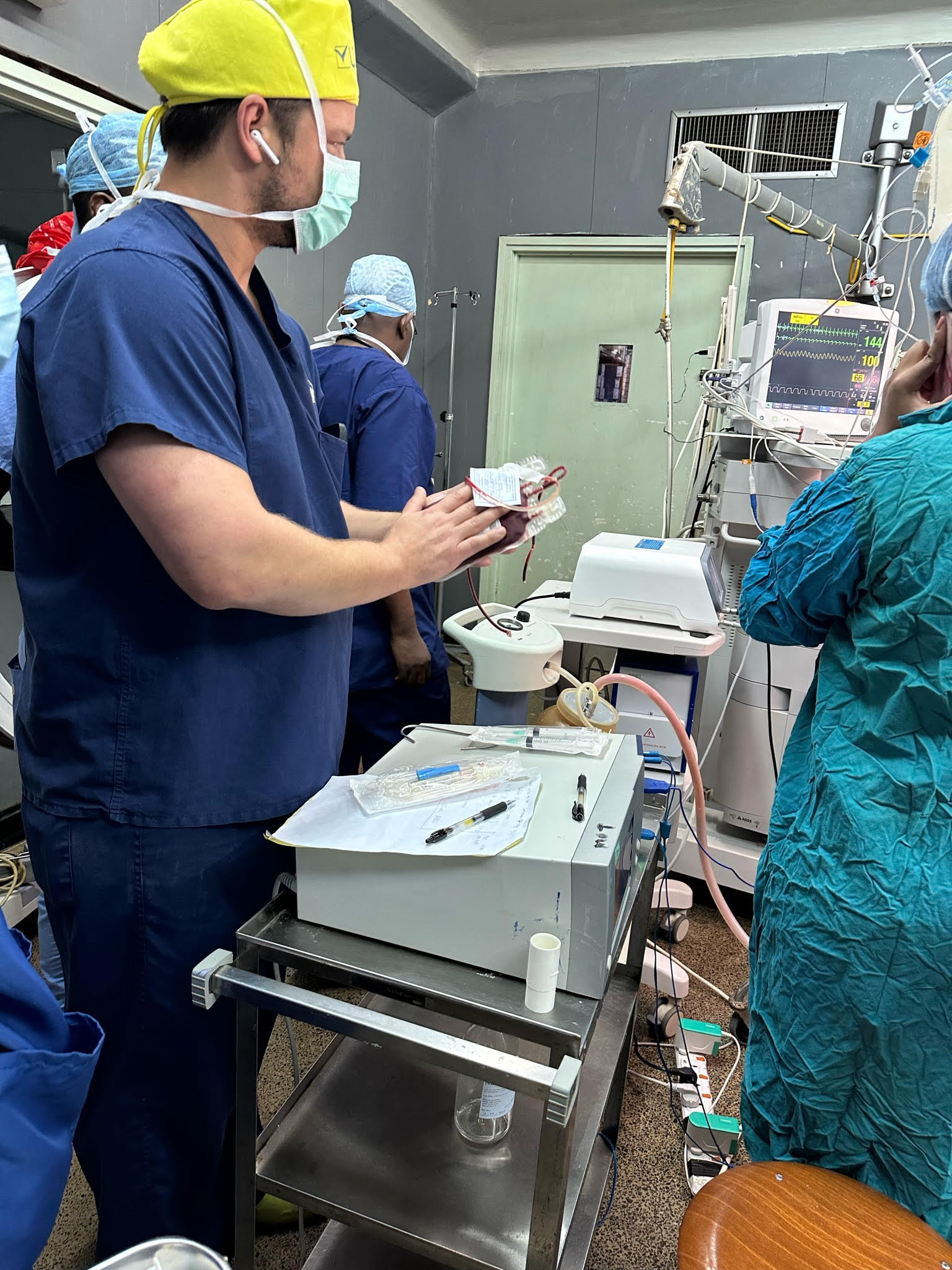
The anesthesia residents, a mix of characters from across Tanzania and beyond, had a unique blend of cultures, religions, and ages. All seemed to have a great sense of humor, which made teaching incredibly enjoyable and rewarding. Pairing with the attendings from Tanzania, we taught lectures on the latest techniques in neuroanesthesia. These include physiology, procedures for vascular access, and monitoring during complex surgery. Residents and faculty shared their experiences with providing lifesaving neuroanesthesia, and we reviewed how best to manage in those tough circumstances. In the operating room, I was allowed to sit with the residents and tell them what to observe and treat based upon my experience at Barrow Neurological Institute and my residency years at Johns Hopkins Hospital.
Despite this, there remains much to be done. Resources ranging from patient warming devices to equipment for advanced blood pressure monitoring, which are key to successful neurosurgery, are in short supply. Having enough anesthesiologists available each day to teach and work one-on-one with residents remains challenging, as the need is high and the total faculty remains small. While the local anesthesiologists are incredibly strong, support is vital to build and grow.
Now hope grows stronger at KCMC, as Barrow Global and KCMC are opening additional operating rooms to teach advanced neurosurgical techniques. By doing so, we enter a time where great neuroanesthesia experiences will be shared by faculty, residents, and medical students who will provide the future of anesthesiology in Tanzania. These “cornerstone” training experiences will provide capable anesthesiologists to facilitate neurosurgery across the country and beyond. At the Barrow Department of Neuroanesthesiology, we are proud of our abilities to share our expertise, education, and experience in locations throughout the world. We seek out these experiences as part of our mission. KCMC has been the kindest and most gracious of partners, and we look to growing together for years to come.
Top photo: Residents, trainees, and surgical staff gather around Dr. Wilhelmi during a collaborative teaching case in the OR at KCMC. This moment reflects Barrow Global’s commitment to hands-on education and cross-disciplinary training in partnership with local teams.