
Find a Researcher
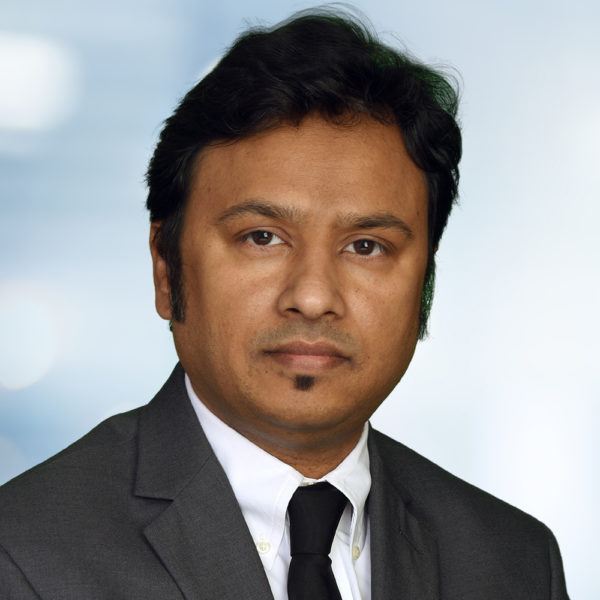
Saif Ahmad, PhD
Saif Ahmad, PhD, is an associate professor in the Department of Translational Neuroscience at Barrow Neurological Institute.
Dr. Ahmad’s expertise includes molecular studies of neurodegenerative diseases. He is a member of the American Heart Association, the Indian Academy of Neurosciences, and the Society for Neuroscience.
Dr. Ahmad earned his doctorate in biotechnology from Hamdard University in New Delhi, India, and his Master of Science in organic chemistry from Mahatma Jyotiba Phule Rohilkhand University in Bareilly, Uttar Pradesh, India. He began his postdoctoral fellowship in the Program in Molecular Medicine at the University of Massachusetts Medical School in Worcester. The laboratory moved to Augusta University in Augusta, Georgia, where he completed his training.
Dr. Ahmad’s current research focuses on the inflammatory mechanisms of stroke. He is particularly fascinated with the molecular mechanisms governing complement C3a receptor and C1q-mediated neurodegeneration, neurovascular dysfunction, and synapse elimination in stroke and in vascular contributions to cognitive impairment and dementia (VCID). Dr. Ahmad is also interested in traumatic brain injury (TBI) and traumatic optic neuropathy (TON) research. His research ideas are funded by Barrow Neurological Foundation, the Arizona Alzheimer’s Consortium (AAC), the Department of Defense (DoD), and the National Institutes of Health (NIH).
- Research Scientist, Texas Tech University Health Sciences Center, 2015-2016
- Associate Professor, King Abdulaziz University, 2012-2015
- Postdoctoral Fellowship, University of Massachusetts Medical School and Augusta University 2007-2012
- PhD, Jamia Hamdard (Hamdard University), New Delhi, Biotechnology, 2004
- MSc, Mahatma Jyotiba Phule Rohilkhand University, Chemistry, 1998
- BSc; Mahatma Jyotiba Phule Rohilkhand University; Botany, Zoology, & Chemistry, 1996
- American Heart Association
- Indian Academy of Neuroscience
- Society for Neuroscience
- R01 Grant Award, National Institutes of Health, National Institute of Neurological Disorders and Stroke, 2024-2029
- Funding Award, United States Department of Defense (DoD), 2022-2025
- Young Faculty Travel Award, International Stroke Conference, American Heart Association, 2022
- Funding Award for “Complement C3aR Deficiency Alleviates VCID Progression,” Arizona Alzheimer’s Consortium, 2021-2022
- Funding Award for “RIC-Therapy: TONing the Neuroprotection in Eye Trauma,” 2021-2022
- Funding Award for “Micro RNA Therapy to Improve Reperfusion in Ischemic Stroke,” 2019-2020
- Training Grant for “Complement-Mediated Signaling in Stroke, Barrow Neurological Foundation, 2017-2018
- Research Associate Fellowship, Ministry of Ayurveda, Yoga & Naturopathy, Unani, Siddha, and Homoeopathy; Ministry of Health and Family Welfare, Government of India, 2004-2005
- Junior and Senior Research Fellowship, Technology Mission on Oilseeds and Pulses, Council of Scientific and Industrial Research, Ministry of Health and Family Welfare, Government of India, 2004
- Senior Research Fellowship, Central Council for Research in Unani Medicine, Ministry of Health and Family Welfare, Government of India 2000-2002
- Hamdard National Foundation Research Fellowship, Hamdard University, New Delhi, 2003-2004
The Complex Role of the Complement C3a Receptor (C3aR) in Cerebral Injury and Recovery Following Ischemic Stroke
Date: 09/2025
Authors: Naseem Akhter, Ateeq Lambay, Reema Almotairi, Abdullah Hamadi, Kanchan Bhatia, Saif Ahmad, Andrew F. Ducruet
Sexually Dimorphic Responses Reveal Multifaceted Benefits of Glibenclamide in Traumatic Brain Injury
Date: 08/2025
Authors: Anupama Rani, Sudhanshu P. Raikwar, Wonsuk Yoo, Saif Ahmad, Vincent A. Vagni, Keri L. Janesko-Feldman, Shaun W. Carlson, Adam Eberle, Margaux Miller, John Helm, Joshua Catapano, Benjamin E. Zusman, Shashvat Desai, Raemier Anne Javelosa, Semeon Afework, Erin Audrey McNally, Gary Kohanbash, Dhivyaa Rajasundaram, Michael F. Waters, Andrew Ducruet, Ashutosh Jadhav, Aditya Kumar, Chia-Ling Phuah, Patrick M. Kochanek, Ruchira M. Jha
Prevalence and clinical considerations of Y chromosome microdeletions in azoospermic and oligozoopsermic infertile men from Al Madinah Al Munawarah, Saudi Arabia
Date: 02/2025
Authors: Monis B. Shamsi, Rima Dada, Reham M. Balahmar, Dimah Zaytuni, Ghadeer Alharbi, Syed N. Imam, Emad Rajih, Muhammad Latif, Saif Ahmad
Remote Ischemic Post-Conditioning (RIC) Mediates Anti-Inflammatory Signaling via Myeloid AMPKα1 in Murine Traumatic Optic Neuropathy (TON).
Date: 12/2024
Authors: Naseem Akhter, Jessica Contreras, Mairaj A Ansari, Andrew F. Ducruet, Md Nasrul Hoda, Abdullah S Ahmad, Laxman D Gangwani, Kanchan Bhatia, Saif Ahmad
Exosomes in Vascular/Neurological Disorders and the Road Ahead.
Date: 04/2024
Authors: Faisal A Alzahrani, Yasir M Riza, Thamir M Eid, Reema Almotairi, Lea Scherschinski, Jessica Contreras, Muhammed Nadeem, Sylvia E Perez, Sudhanshu P Raikwar, Ruchira M Jha, Mark C Preul, Andrew F Ducruet, Michael T Lawton, Kanchan Bhatia, Naseem Akhter, Saif Ahmad
Phoenix, AZ 85013
Saif Ahmad, PhD
Saif Ahmad, PhD, is an associate professor in the Department of Translational Neuroscience at Barrow Neurological Institute.
Dr. Ahmad’s expertise includes molecular studies of neurodegenerative diseases. He is a member of the American Heart Association, the Indian Academy of Neurosciences, and the Society for Neuroscience.
Dr. Ahmad earned his doctorate in biotechnology from Hamdard University in New Delhi, India, and his Master of Science in organic chemistry from Mahatma Jyotiba Phule Rohilkhand University in Bareilly, Uttar Pradesh, India. He began his postdoctoral fellowship in the Program in Molecular Medicine at the University of Massachusetts Medical School in Worcester. The laboratory moved to Augusta University in Augusta, Georgia, where he completed his training.
Dr. Ahmad’s current research focuses on the inflammatory mechanisms of stroke. He is particularly fascinated with the molecular mechanisms governing complement C3a receptor and C1q-mediated neurodegeneration, neurovascular dysfunction, and synapse elimination in stroke and in vascular contributions to cognitive impairment and dementia (VCID). Dr. Ahmad is also interested in traumatic brain injury (TBI) and traumatic optic neuropathy (TON) research. His research ideas are funded by Barrow Neurological Foundation, the Arizona Alzheimer’s Consortium (AAC), the Department of Defense (DoD), and the National Institutes of Health (NIH).
Phoenix, AZ 85013
- Research Scientist, Texas Tech University Health Sciences Center, 2015-2016
- Associate Professor, King Abdulaziz University, 2012-2015
- Postdoctoral Fellowship, University of Massachusetts Medical School and Augusta University 2007-2012
- PhD, Jamia Hamdard (Hamdard University), New Delhi, Biotechnology, 2004
- MSc, Mahatma Jyotiba Phule Rohilkhand University, Chemistry, 1998
- BSc; Mahatma Jyotiba Phule Rohilkhand University; Botany, Zoology, & Chemistry, 1996
- American Heart Association
- Indian Academy of Neuroscience
- Society for Neuroscience
- R01 Grant Award, National Institutes of Health, National Institute of Neurological Disorders and Stroke, 2024-2029
- Funding Award, United States Department of Defense (DoD), 2022-2025
- Young Faculty Travel Award, International Stroke Conference, American Heart Association, 2022
- Funding Award for “Complement C3aR Deficiency Alleviates VCID Progression,” Arizona Alzheimer’s Consortium, 2021-2022
- Funding Award for “RIC-Therapy: TONing the Neuroprotection in Eye Trauma,” 2021-2022
- Funding Award for “Micro RNA Therapy to Improve Reperfusion in Ischemic Stroke,” 2019-2020
- Training Grant for “Complement-Mediated Signaling in Stroke, Barrow Neurological Foundation, 2017-2018
- Research Associate Fellowship, Ministry of Ayurveda, Yoga & Naturopathy, Unani, Siddha, and Homoeopathy; Ministry of Health and Family Welfare, Government of India, 2004-2005
- Junior and Senior Research Fellowship, Technology Mission on Oilseeds and Pulses, Council of Scientific and Industrial Research, Ministry of Health and Family Welfare, Government of India, 2004
- Senior Research Fellowship, Central Council for Research in Unani Medicine, Ministry of Health and Family Welfare, Government of India 2000-2002
- Hamdard National Foundation Research Fellowship, Hamdard University, New Delhi, 2003-2004
The Complex Role of the Complement C3a Receptor (C3aR) in Cerebral Injury and Recovery Following Ischemic Stroke
Date: 09/2025
Authors: Naseem Akhter, Ateeq Lambay, Reema Almotairi, Abdullah Hamadi, Kanchan Bhatia, Saif Ahmad, Andrew F. Ducruet
Sexually Dimorphic Responses Reveal Multifaceted Benefits of Glibenclamide in Traumatic Brain Injury
Date: 08/2025
Authors: Anupama Rani, Sudhanshu P. Raikwar, Wonsuk Yoo, Saif Ahmad, Vincent A. Vagni, Keri L. Janesko-Feldman, Shaun W. Carlson, Adam Eberle, Margaux Miller, John Helm, Joshua Catapano, Benjamin E. Zusman, Shashvat Desai, Raemier Anne Javelosa, Semeon Afework, Erin Audrey McNally, Gary Kohanbash, Dhivyaa Rajasundaram, Michael F. Waters, Andrew Ducruet, Ashutosh Jadhav, Aditya Kumar, Chia-Ling Phuah, Patrick M. Kochanek, Ruchira M. Jha
Prevalence and clinical considerations of Y chromosome microdeletions in azoospermic and oligozoopsermic infertile men from Al Madinah Al Munawarah, Saudi Arabia
Date: 02/2025
Authors: Monis B. Shamsi, Rima Dada, Reham M. Balahmar, Dimah Zaytuni, Ghadeer Alharbi, Syed N. Imam, Emad Rajih, Muhammad Latif, Saif Ahmad
Remote Ischemic Post-Conditioning (RIC) Mediates Anti-Inflammatory Signaling via Myeloid AMPKα1 in Murine Traumatic Optic Neuropathy (TON).
Date: 12/2024
Authors: Naseem Akhter, Jessica Contreras, Mairaj A Ansari, Andrew F. Ducruet, Md Nasrul Hoda, Abdullah S Ahmad, Laxman D Gangwani, Kanchan Bhatia, Saif Ahmad
Exosomes in Vascular/Neurological Disorders and the Road Ahead.
Date: 04/2024
Authors: Faisal A Alzahrani, Yasir M Riza, Thamir M Eid, Reema Almotairi, Lea Scherschinski, Jessica Contreras, Muhammed Nadeem, Sylvia E Perez, Sudhanshu P Raikwar, Ruchira M Jha, Mark C Preul, Andrew F Ducruet, Michael T Lawton, Kanchan Bhatia, Naseem Akhter, Saif Ahmad