
Cochlear Implant
At a Glance
- A cochlear implant is a device designed to reverse the type of hearing loss that stems from damage to your inner ear (sensorineural hearing loss).
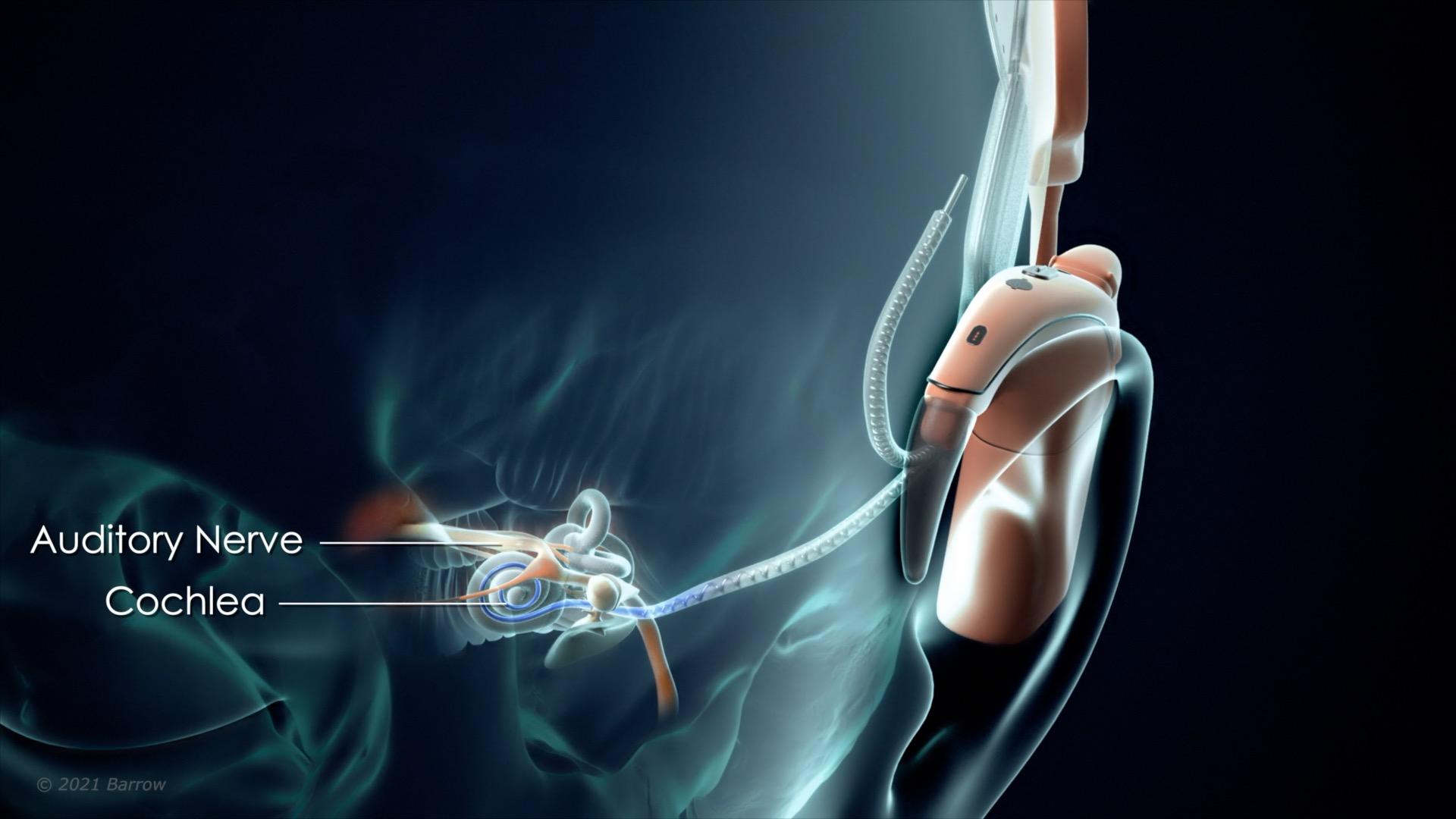
- During cochlear implant surgery, your surgeon places the device into the cochlea—the inner ear hearing organ. The implant is very small and is placed using a microscope. The implant has an electrode, which looks and feels similar to a thread, and is wound around the auditory nerve. Once installed, it works by bypassing the damaged cochlea to stimulate the auditory (hearing) nerve directly.
- The cochlear implant, once activated, revives the auditory (hearing) nerve. It allows signals to reach the auditory cortex and associated structures of the brain that process hearing.
- In a sense, these hearing signals revive the brain and allow it to regenerate the ability to process hearing. This regeneration is also known as neuroplasticity and allows an adult patient with a cochlear implant to hear again.
- People of all ages can receive a cochlear implant, and your surgeon will help determine if you are a good candidate for the procedure.
Overview
A cochlear implant is a surgically implanted device designed to help restore hearing loss that originates from the inner ear, known as the cochlea, or from the auditory (hearing) nerve. This type of hearing loss is known as sensorineural hearing loss.
In a person with normal hearing, the cochlea transforms sound into electrical signals for the brain to interpret. However, when the cochlea is unable to process sound waves clearly, severe hearing loss can occur. This disorder usually occurs due to damage inside the cochlea itself and is termed sensorineural hearing loss.
Hearing aids work by amplifying sound to make it easier for a damaged cochlea to do its work. However, when a cochlea has sustained too much damage, it can no longer process the sound, regardless of how loud it is. This shortcoming of hearing aids is where cochlear implants come into play. These devices are able to bypass the damaged part of the cochlea and directly stimulate the auditory (hearing) nerve, allowing sound signals to once again reach the brain.
Cochlear implants can help both children and adults with severe and progressive sensorineural hearing loss. They are especially beneficial to people who no longer benefit from hearing aids.
How the Cochlea Helps You Hear
The cochlea is the primary hearing organ found within the inner ear, which also controls some parts of balance and equilibrium. It is a small, snail shell-shaped structure located just inside the eardrum and middle ear space where the hearing bones are located. The shape of the cochlea allows the organ to be more compact than it would be if structured as a straight line. All of these structures are encased in a very strong part of the skull called the temporal bone, which is directly behind your outer ear.
As sound travels from your outer ear and through your ear canal, it impacts the eardrum. This impact causes the eardrum to vibrate, which in turn vibrates your hearing bones (called ossicles) in the middle ear. The ossicles transfer that sound energy directly into the cochlea. As these sound energies vibrate through the cochlear fluids, they cause tiny internal membranes to “ripple”, similar to an audio speaker in your home or car. These ripples, in turn, activate specialized nerve endings called hair cells along the length of the cochlea.
The hair cells that line the length of the cochlear spiral each detect a specific frequency, or pitch, of sound that is unique to their position within the cochlea, similar to the arrangement of keys on a keyboard. As such, hearing a sound at a specific frequency will cause hair cells in certain portions of the cochlea to vibrate more than others, sending distinct signals along the auditory nerve.
These signals travel up the nerve endings to the center of the cochlea, where they merge into the cochlear-vestibular nerve, also known as the auditory (hearing) nerve. This nerve then carries the electrical signals of hearing to a portion of the brain called the auditory cortex, where they’re interpreted and processed as recognizable sounds. Other parts of the brain interact with this area to allow the brain to react to sound, experience emotion, recall memories, and interact with people and the world around them.
What kind of hearing loss do cochlear implants treat?
Cochlear implants primarily treat sensorineural hearing loss, which happens when the hair cells in the cochlea are damaged or degraded. Such damage prevents sound from being properly converted into electrical signals that the auditory nerve can carry to the brain. In most patients, however, the auditory nerve and brain remain functional and healthy. They are simply waiting for a signal that never comes. This form of damage is also the cause of most forms of tinnitus. The brain, lacking stimulation, creates the tinnitus sound – in effect filling in the gaps. Cochlear implants bypass these damaged cells to stimulate the auditory nerve directly and restore a signal to the brain.
Some people with sensorineural and conductive hearing loss—known as mixed hearing loss—are candidates for cochlear implants if the sensorineural loss is severe and hearing aids no longer provide sufficient benefit. Unfortunately, cochlear implants do not treat conductive hearing loss, or hearing loss where sounds are mechanically blocked from passing into the inner ear. This type of hearing loss encompasses conditions like perforated eardrums, impacted earwax, and disorders of the hearing bones.


How Cochlear Implants Work
A cochlear implant revives the ability of the auditory nerve to bring sound signals to the brain. In effect, the cochlear implant wakes up the hearing regions of the brain, restoring their activity and regenerating their ability to process sound – a process called neuroplasticity. This process is most pronounced in infants and young children, but it can happen in people of all ages. The working face of the implant, called the electrode, is a very small, thread-like structure inserted by your surgeon into the spaces of the cochlear spiral. The electrode thread is designed with a series of microscopic stimulators that can activate different regions of the cochlea in a very controlled way. In this manner, the cochlear implant can stimulate different combinations of hair cells within the spiral to reproduce the combinations of pitches that form a sound you hear. As this signal reaches the healthier upper portions of the nerve and transitions to the brain, the hearing pathways are reactivated.
A cochlear implant includes the following parts:
- A microphone that picks up sound from your surroundings.
- A speech processor that arranges the sounds picked up by the microphone.
- A transmitter that receives signals from the speech processor and a stimulator that converts them into electric impulses.
- A thread-like grouping of electrodes that relays the electric impulses from the stimulator and transmits them to the auditory nerve.
Cochlear implants differ from standard hearing aids and do not restore normal hearing. Rather, they offer a far more powerful way to help people hear sounds, understand speech, and engage socially. In adults, restoring the ability to socially interact with other people is one of the most important ways to protect cognitive health, happiness, and longevity. For infants and children, this process is key to social participation and the ability to engage with normal hearing peers meaningfully.
Cochlear implants have been in development for more than 60 years, with the first device receiving FDA approval in 1984. Modern implants are in their seventh generation and are highly advanced compared to the initial devices used in the 1980s. Over this time, cochlear implants have undergone significant evolutions in their design, biomechanics, materials, sound processing, computing, size, and aesthetics. These design refinements have enabled remarkable leaps in hearing function, speech-language capabilities, environmental awareness, and, for some patients, an enhanced ability to hear and appreciate music.
For infants and small children, a cochlear implant may allow them to hear their world for the first time and develop spoken language skills that may not have developed otherwise. Research shows that when children receive a cochlear implant and intensive listening therapy at a young age (ideally between 6-18 months old), they have a chance for hearing performance similar to other children born with normal hearing.
Compared with adults, the timing of cochlear implantation in children is very important.
In most adults, the ability to hear was present earlier in life, allowing the auditory nerve and auditory cortex of the brain to form normally. Thus, a cochlear implant in adult patients allows them to reclaim the ability to hear that was already there. Due to this mechanism, the age of implantation for adults is much less important than in children. With proper social and family support and a willingness to complete the work needed for hearing rehab with a cochlear implant, even very elderly adults can benefit from this technology.
What Is It Like to Hear Again? The Journey of Cochlear Implant Activation and Rehabilitation
For patients with severe to profound hearing loss, a cochlear implant can provide access to sounds that are difficult or impossible to hear. But receiving a cochlear implant is not like putting on a pair of glasses and immediately seeing clearly.
For most adult patients, the cochlear implant triggers a process of regeneration and rejuvenation in the brain as the hearing signals reach it via the auditory nerve. This process typically takes a few months, over which you should notice steady and gradual improvement in hearing ability and clarity. From the emotional first activation to months of listening therapy and brain adaptation, the cochlear implant experience is ultimately a story about neuroplasticity—your brain’s remarkable ability to learn, adapt, and make sense of new information. This story is different in every patient, and an amazing testament to the abilities of the human brain.
The Day of Activation: Excitement Meets Surprise
Several weeks after surgery, you’ll return to your audiologist for activation day. For the first time, your audiologist will connect the external processor and turn on the implant.
Many people arrive expecting to hear voices the way they remember them immediately. Instead, the first moments can be surprising.
Some describe voices as robotic, electronic, cartoon-like, or metallic. Others say people sound like they are speaking through a computer, a synthesizer, or that they sound like a science-fiction movie character. Environmental sounds can be equally unfamiliar. A door closing, footsteps, rustling paper, running water, or a car engine may seem strange and difficult to identify. This is because, for the first time in your life, you are hearing electrically instead of acoustically.
For some, activation can be emotional. Those who have lived in silence for years may hear sounds they have not experienced in decades. Family members’ voices, birds outside a window, or the hum of everyday life can bring tears, joy, relief, and sometimes frustration—all within the same appointment.
This reaction is normal.
The cochlear implant is successfully delivering sound information to the auditory nerve, but your brain has not yet learned how to interpret the new electrical signals.
The First Few Days: A Flood of New Information
After activation, you might notice that the world suddenly feels louder and busier.
Sounds that people routinely ignore—a ticking clock, air conditioning vents, shoes on the floor, clothing brushing against skin—become impossible to overlook.
Your brain is receiving a tremendous amount of auditory information, much of which it has not processed for months, years, or even decades.
During this period, listening can feel mentally exhausting. Many people report fatigue after conversations because their brains are working hard to decode sounds that once seemed effortless.
This stage can be discouraging if your expectations don’t align with reality. People often ask if this is really how things are supposed to sound. The answer is yes, but you’ll soon notice a change.
The First Month: The Brain Begins to Adapt
The human brain is remarkably adaptable. With consistent use of the cochlear implant, neural pathways begin reorganizing themselves to interpret the incoming signals more effectively.
Gradually, voices become easier to distinguish.
You might notice small but meaningful milestones:
- Recognizing a spouse’s voice without looking
- Hearing a telephone ring
- Understanding a familiar phrase
- Identifying environmental sounds correctly
- Following portions of a conversation
At first, speech may still sound artificial, but your brain is steadily building connections between these new auditory signals and memories of language.
Many people compare the experience to learning a new language. The sounds are present from day one, but understanding develops through repetition and practice.
Listening Therapy: Training the Brain to Hear
One of the most important parts of cochlear implant success happens outside the clinic.
Listening therapy, sometimes called auditory rehabilitation, will help you reteach your brain how to interpret sound.
Therapy may involve:
- Listening to recorded words and sentences
- Practicing conversations with family members
- Identifying environmental sounds
- Following audiobooks while reading printed text
- Completing computer-based auditory training exercises
- Participating in structured speech perception programs
The goal is not to train the implant, which is already functioning. Rather, the goal is to train your brain.
Each listening experience strengthens neural pathways that support speech understanding and sound recognition. Research consistently shows that people who actively engage in rehabilitation often achieve better outcomes than those who rely on passive listening alone.
Three to Six Months: Sound Becomes More Natural
As the months pass, you’ll likely notice substantial improvements: Voices that once sounded robotic begin to sound more natural, conversations require less concentration, and background sounds become easier to filter.
People often report reaching a point where they suddenly realize they are no longer actively thinking about hearing.
Instead of focusing on decoding every sound, they are simply participating in conversations, enjoying music, watching television, or interacting with family and friends.
For many individuals, this period marks a turning point.
The technology begins to fade into the background, and communication becomes the focus again.
Six Months and Beyond: The New Normal
The timeline varies from person to person, but many cochlear implant recipients continue improving for one to three years after activation.
By this stage, patients frequently describe hearing as feeling natural—not necessarily identical to hearing before hearing loss, but effective, reliable, and deeply meaningful.
Many are able to:
- Communicate more confidently in everyday situations
- Participate in social activities
- Use the telephone
- Enjoy television and media with less reliance on captions
- Recognize familiar voices
- Navigate the world with greater awareness and independence
The brain has adapted to the implant’s signals and incorporated them into everyday life.
Some recipients even report forgetting they are wearing the device because hearing becomes integrated into their daily routine.
Every Journey Is Unique
No two cochlear implant experiences are exactly alike, as no two brains are exactly alike.
Age, the overall health of the auditory system, brain and cognitive health, degree of social and family support, consistency of device use, and participation in rehabilitation all influence outcomes. Some patients progress rapidly, while others require more time and practice.
What remains consistent is the brain’s capacity to learn.
The cochlear implant provides access to sound, but it is the brain that transforms those signals into meaningful communication. Through neuroplasticity, persistence, and rehabilitation, many patients move from hearing unfamiliar electronic sounds to reconnecting with conversations, relationships, and experiences that enrich daily life.
A single activation appointment does not define the cochlear implant journey. It is a process of discovery, adaptation, and renewal—one in which technology and the human brain work together to restore connection to the world of sound.
The Barrow Difference
At Barrow Neurological Institute, our team of cochlear implant surgeons, audiologists, and researchers can help determine if a cochlear implant is an option for you. If you’re a good candidate, you’ll be able to select an implant that best meets your needs, and we’ll counsel you on how it will work and the results you should expect.
Typically, cochlear implant surgery lasts less than an hour and is performed on an outpatient basis. On occasion, depending on a patient’s age and health, your surgeon might recommend a 1-night hospital stay. After surgery, our audiologists will help train your brain on how to hear using a cochlear implant. This journey to functional hearing can last anywhere from 2-12 months.
Common Questions
How common are cochlear implants?
In the United States, estimates suggest that more than 600,000 adults and children have received cochlear implants since the FDA first approved them in the mid-1980s. Worldwide, these estimates exceed 1 million implants since their first use.
That said, the number of cochlear implants placed still lags far behind the number of patients who can benefit from them. Although the number of cochlear implants performed each year has steadily increased, researchers estimate that fewer than 10% of medically eligible patients have received a cochlear implant in the U.S.
Who uses cochlear implants?
Cochlear implants can help both children and adults with severe to profound sensorineural hearing loss—approximately 80% of implant recipients are adults, while 20% are children. Earlier use of cochlear implants generally leads to better outcomes, although many adults benefit even after years of hearing loss.
How do I know if I’m a good candidate for a cochlear implant?
You may be a candidate for a cochlear implant if moderate-to-severe sensorineural hearing loss in one or both ears is significantly affecting your ability to understand speech and impacting daily communication, work, or social life, despite well-fitted hearing aids.
Your inner ear and auditory nerve must also be intact and capable of carrying signals to the brain, and your brain must also be healthy with no prior history of stroke, tumor, or other damage. Finally, you’ll need to be motivated to wear the device consistently and participate in follow-up care and listening therapy.
What kind of results can I expect with cochlear implants?
Cochlear implant outcomes tend to be most successful when implants are used for sensorineural hearing loss with a healthy auditory nerve in properly selected patients. A good social support network and a motivated patient are also very important to a great outcome.
While results will vary, most people with a cochlear implant experience meaningful benefits, including:
- Improved awareness of sounds: After a cochlear implant, many patients can detect environmental or ambient sounds they previously could not hear, such as footsteps, birds, traffic, or alarms.
- Improved understanding of speech and communication: Most implant users report an enhanced ability to comprehend spoken language, particularly in quiet settings. As a result, easier communication can lead to more social engagement and independence.
- Improved speech development in children: Children who receive cochlear implants early often develop spoken language skills in line with those of their peers, particularly with the support of therapy and their families.
It’s important to note that hearing with a cochlear implant is not an immediate return to normal hearing. The brain needs time, practice, and auditory therapy to learn how to interpret the new signals from the implant—meaning that improvements in hearing and communication can continue over a span of years.
Are there any side effects to cochlear implants?
Cochlear implants are generally safe, but like any surgery or medical device, they carry some potential side effects. These can include:
- Device-related issues: Rarely, the cochlear implant may fail and require revision surgery to replace the malfunctioning device. This rate is publicly reported to the government by all manufacturers and currently is around three device malfunctions for every 1,000 implanted.
- Surgical risks: As with any surgical procedure, potential risks include infection, bleeding, dizziness, and temporary pain at the incision site.
- Temporary dizziness or balance issues: Some people experience dizziness or balance issues after surgery, which generally improve over time.
- Changes in taste: Although temporary, an altered or metallic taste sensation can occur due to the proximity of the implant to the nerves that connect your taste buds to your brain.
- Sound quality differences: In the early stages of implant use, sounds may initially seem artificial or robotic.
- Residual hearing loss: Any remaining natural hearing in the ear with the cochlear implant may be reduced or lost.
Resources
Videos